Thursday, December 22, 2011

If Cows Were Meant to Fly

Rose died this month. She was only 8 months old. She was my littlest Guernsey Girl and I was especially proud of her because she was my first AI calf. She made me a "daddy", and I fell in love with her the moment she was born.


She was a very special and valuable little cow. You see, she was supposed to grow up and share her milk with us and our friends. It was her destiny from the moment she was conceived to group up and live her life in Paradise. She was going to be one of the rare milk cows who actually walks on green pasture, eats grass, spends hot afternoons hanging out under an old apple tree, and is known by a beautiful name, not a number. I was going to hug her often and know that if she had arms, she'd hug me too. But I was going to be satisfied with a wet kiss on the cheek.

She was a registered Guernsey - Ava's Paradise Rose. That was important because like so many livestock breeds that aren't popular for huge commercial farm/ranch operations, Guernseys are on the American Livestock Breed Conservancy list of "watched" livestock breeds. Their numbers are declining rapidly. Holsteins (the huge black and white cows) star in the California dairy ads. They outproduce any other dairy cow for quantity, but their milk has little butter fat. Old timers refer to it as "blue milk." Dairies use Jerseys to add fat. They have the highest butter fat content in their milk. So, there's no place for Guernseys in the quantity-centered commercial dairy world where cows need to produce in a confined environment. And it's a shame. Because Guernseys produce a unique milk that is truly unlike any other dairy breed in the world.

Guernseys are known for producing high butter-fat (5%), high protein (beta casein A2) milk with a high concentration of beta carotene. Combined, these give Guernsey milk its wonderful, rich flavor and beautiful gold color.

You're curious. How did Rose die? She ate corn. But we don't feed our cows corn. They're grass-fed. You're right. Little Rose escaped from her pasture one night and got out onto the road where I had put poultry feeders with corn and wheat for our turkeys and chickens that roam about. She couldn't help herself and ate all the chicken feed in the feeders. She didn't eat rat poison, fertilizer, or herbicide. She just ate corn. In less than 24 hours, she was critically ill. Because cows don't have wings. Her sensitive and complicated digestive system was meant only for grass and its pH was neutral. Mature grains like corn turn a cows gut acid - destroying all the beneficial bacteria responsible for digestion, thus shutting it down. The acid also destroys the lining of the gut. Despite Ross's heroic efforts, consultations with our vet, and all our love, little Rose hemorrhaged and bled to death.

A lot of folks like their corn-fed beef. They like the higher fat content and the "marbling" beef has when it's corn-fed. What most people don't know is that cows are corn-fed in feedlots only for a short period of time. 60 - 90 days. Because the day they start eating grain, they start dying. They have to be fed antibiotics with their feed because without a normally functioning gut, they are susceptible to all kinds of infections and illnesses. To keep them alive until they're fat enough to slaughter, they're also fed antacids. Sweeteners, like molasses, are added to the grain to get them to eat even more than they normally would. After all, the clock is ticking and they need to be fat enough before they're slaughtered or die on the feedlot from eating corn.

I'll never forget Rose. I artificially inseminated Dicey and conceived my first calf. I watched Dicey give birth and touched her calf when she was just minutes old. I named her after my grandmother who died the week she was born. I bottle-fed her for many months. I picked out the little red calf halter that she wore so I could grab her when she was being naughty. Along with Xubie, they were my "kids."


I hope Rose can teach a lesson to folks who don't know much about their meat and the animals that provide it.


If cows were meant to fly, they'd have wings. 

About Guernseys

The Guernsey breed originated about 1000 years ago. Three monks on the Isle of Guernsey bred cows to produce the characteristic golden milk that Guernseys are now famous for. Today, science has confirmed that these dudes were really onto something.

Guernsey milk has three distinct qualities that set it apart from the milk of all other dairy breeds: high levels of beta carotene, high levels of omega 3, and the protein (casein) A2. Evidence suggests that Guernseys excel in absorbing the nutrient carotene and transferring it to butterfat. This extra carotene is what gives Guernsey milk its gold color along with cream and butter. Everyone who has sampled our Paradise butter knows how amazingly bright and yellow it is in the summer when our Guernsey Girls are eating green grass. Guernsey milk also contains three times as much omega 3 as other milk. And the ratio is considered to be superior - 1part omega 3 to 2 parts omega 6. Other milk is 1 part omega 3 to 6 parts omega 6. Recently, Guernsey milk is getting more attention because of the type of protein it contains. Guernseys are the only breed of the 6 major dairy breeds that carry 95% or more of their beta casein as A2/A2. Other breeds are between 33% and 50%. These breeds carry the A1 protein. Some research suggests that A1 protein may exacerbate conditions for people with compromised immune systems and cause diabetes, heart disease and other illnesses. But the protein A2 does not. Many people report that they are "lactose intolerant" and cannot drink most cow milk, but Guernsey milk is OK.

What do I think of all this science and research? I don't know. I'm not a scientist or a health practitioner. You should do your own research. What I know is that Ross gave me Dicey as a gift expecting that her special milk would help heal my gut (from Crohn's disease) and restore my health. Today, I drink vast amounts of raw milk from all my Guernsey Girls and eat sunshine-in-a-stick at every opportunity. You be the judge.

You can find more details on the web:

Saturday, July 2, 2011

Out of the Oyster

In February of this year, we got a pearl out of an oyster. Yep, we brought another Guernsey cow home to Paradise from a commercial dairy. She fits right in here at the ranch and is a wonderful, if bossy, companion for our other milk cow, Dicey. And her name is Pearl.

We bought Pearl so that we could have fresh milk year-round. In order to achieve that, it's necessary to have two milk cows because one will always need to be dried up (stop giving milk) for several months before she has her new calf. In addition to that, I just love Guernsey cows. They're beautiful, friendly, full of personality and they're actually an endangered livestock breed. I'm very proud of my little Guernsey herd and happy to give them a wonderful home.

Dicey and Pearl have actually come to us from the same dairy. We're sure they would never want to return. To be truthful, we have a great deal of compassion for the dairyman who operates that dairy. He's an older man who loves his cows and is dedicated to his life as a dairyman. He has very little interest or help from his family and children and consequently his operation and animals suffer from neglect.

His operation is very typical of the vast majority of commercial dairies. Cows are kept in small pens and fed rations of grain and chopped hay. They are never far from the milk barn. They spend most of their day standing in manure while waiting to be milked.

Waiting to be milked

Pearl, like most dairy cows, spent her days standing on concrete floors covered in mud and manure. When she came to Paradise, she had mud and manure caked on her legs so heavily that we were afraid to remove it for fear of pulling off the hair and skin. Standing on hard concrete causes swelling at the top of the foot. Because Pearl spent 8 years in such an environment, her feet are permanently enlarged.

That's a lot of poop
Cows produce a LOT of manure every day. It's no wonder that cows kept in close quarters are not clean. And it's no wonder that their milk has to be not just pasteurized  but "ultra" pasteurized in order for it to be safe to drink.

"Can we be friends?"
This Jersey cow was one of Pearl's companions. Because milk cows have been bred for thousands of years to live in close proximity to humans, they are wonderfully social and curious. They love pats, treats, and interacting with people as well as other dairy cows. And because I live in a very remote area, Dicey, Pearl, and Spicy are my best girlfriends. I scratch their favorite itchy spots and in return get big, wet, smoochy kisses on my cheek.

Standing in line
What our Paradise cows and commercial cows have in common is that twice a day, every day for the entire time they are fresh, they need to be milked. Every 12 hours, our girls show up at the barn waiting for the relief that comes with an emptied udder. And every 12 hours, the commercial cows line up and wait their turns.

Done, for now
It takes about 20 minutes in the milk parlor and they're done. They know the routine well. They march out and return to the same filthy paddock where they will eat and wait for another 12 hours.

But our Pearl is out of the oyster.


Pearl on July 1, 2011

When Pearl first came to us, she habitually stood right near the barn all the time. She didn't know she could walk far and she'd never eaten hay that wasn't chopped up. Needless to say, this spring when we turned her out on pasture, it was a new experience for her. She had never eaten green grass.

For the first time in her life, Pearl now enjoys walking on green pasture and grazing among her friends all day. When it's hot, she lays under an apple tree in the shade. And when she's thirsty, she walks to the cool creek to get a drink. She's loving her life at Paradise.

But if you look real close, you'll see a little piece of the oyster. (She has a bump of a horn on the left side of her head.)

Thanks, Mia, for the beautiful and very fitting name.

Monday, April 18, 2011

Life sucks, and then . . .

Life sucks, and then you drag yourself up, dust yourself off and take a step forward like you mean it. Like you really mean to keep right on living in spite of everything. All of us have this happen numerous times during our lives.

For me, it happened once again just about 2 weeks ago. No doubt, ranching is dangerous work - big equipment, big animals, and big spaces make for big risks. Ross and I always work with safety in mind, but this one day doing a chore we do every day all winter, we lost sight of each other. The spring snow was very thick and visibility was only a few feet. Ross thought I was on the hay wagon. I thought Ross was in the tractor. So, I hopped off the hay wagon and walked between the wagon and the tractor to connect them by putting the pin in the tongue. Like I've done a million times.

But Ross wasn't in the tractor. He was driving the truck and trailer forward to get them out of the road. What he couldn't see was that the trailer caught on some of the bales on the hay wagon and pulled the wagon forward with it. When I realized the hay wagon was coming toward me, I tried to get out of the way. But I wasn't fast enough. Just as I was getting clear, the hay wagon hit my hip and pinned me against the tractor's 3-point.

As I felt the 3-point push into my pelvis, I screamed for Ross. He heard me and immediately thought that somehow some bales of hay had fallen on me. It only took him a few seconds to find me where I was being crushed by the heavy equipment. He jumped in the tractor and moved it forward. I fell to the ground.

The pressure had crushed the soft tissue in my pelvis and broken a piece of the bone off the top. Ross was trying to help me and determine how I was hurt, but I was telling him not to touch me because the pain was excruciating. Knowing that it would take several hours to get to the hospital by ambulance, Ross made the decision to get me in the truck and make the drive himself. That would cut the time down to 45 minutes. I gritted my teeth, and Ross was able to pick me up and load me in the truck. Off we went.

I spent a few days at the hospital enjoying soothing pain medications, caring doctors, and helpful nurses. The physcial therapists taught me how to use crutches, and I practiced getting in and out of bed. But when Ross picked me up to take me home, I was feeling pretty depressed. According to the orthopedic surgeon, it would take 3 months to recover. All of Spring. No milking, no working cows, no planting my garden, no riding my horses, no . . . . Life sucks.

But I have company. The week before the accident, our friend and neighbor, Roddy Campbell, killed himself. He was an ornery, old farmer with a mean streak. I bought my property in Summerville (which we call Eden) from Roddy, and I couldn't help but admire his tough, stubborn nature and his love for butter. He had health issues and was afraid the time would come very soon when he couldn't farm anymore. So, he borrowed a gun from his son and walked into his barn and shot himself. Life sucks.

While I was in the hospital, another neighbor on the same street, Jude, lost his home and all his belongings when his house burned down. Despite the best efforts of neighbors who used their tractors to pull firetrucks out of the mud in the road to get them close to the house, they didn't get help fast enough. Nothing is left. Life sucks.

A few days after leaving the hospital, our friend, Beryl, called. Roddy's son, Rocky, had been life-flighted to a hospital in Boise, Idaho, after suffering a major heart attack. Rocky lives across the street from Eden. He was one of the neighbors who tried to help save Jude's house. Now, he was getting a stint put in one of his heart's arteries. At least he wasn't in the 98% of people who have that type of heart attack and die. Life sucks.

But on this beautiful Monday, most of us in my little town who have experienced life's suckiness this month, have dragged ourselves up, dusted ourselves off, and are taking steps forward like we mean it. My experiences have reminded me that not everybody gets that opportunity, and not everybody makes that choice - to live life like you mean it.

Speaking for myself, I'm gonna be back in the saddle in weeks. Not months. Just you watch. I mean it.

Monday, December 20, 2010

What I've Learned From our Barn Cats

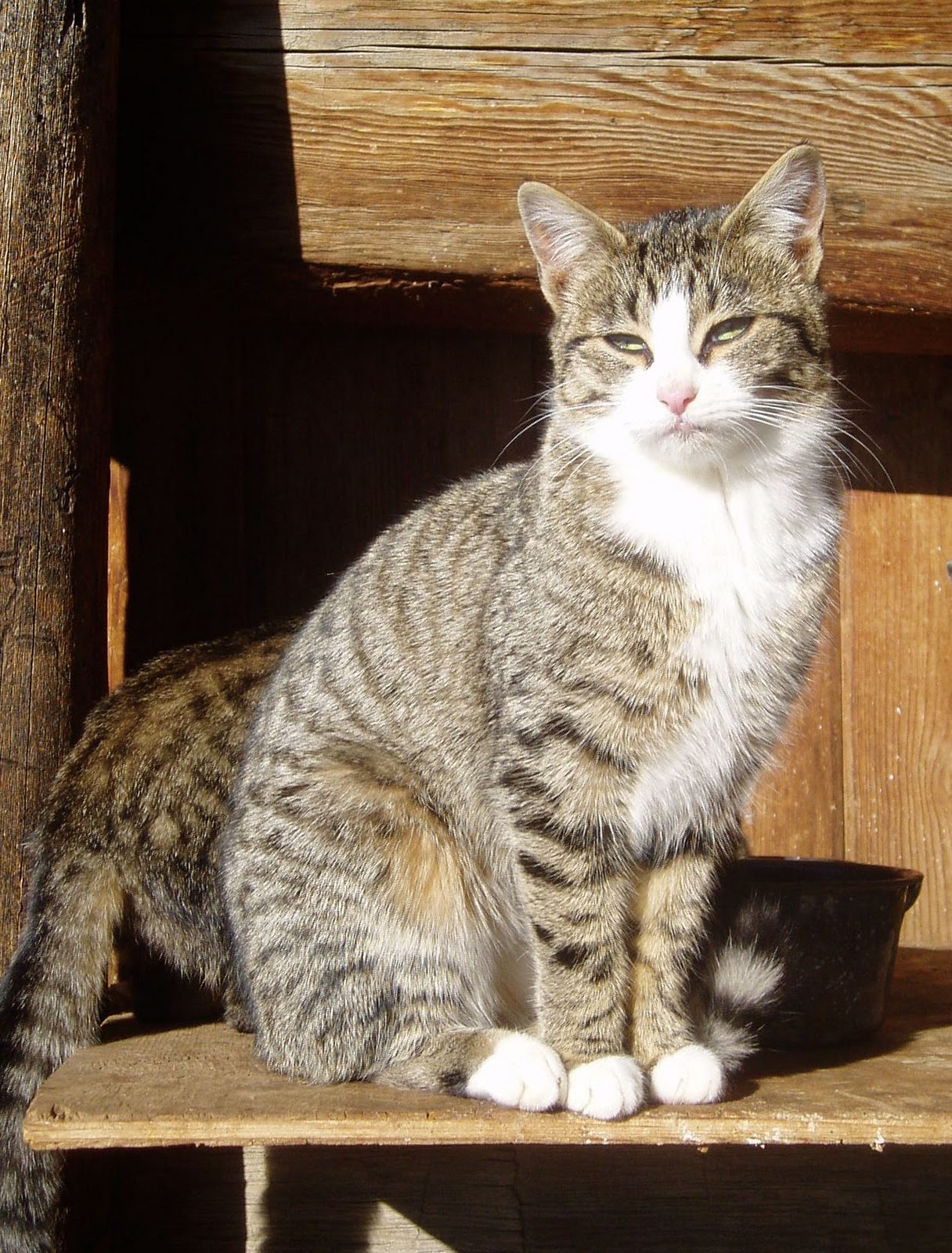
As of this blog, we have 11 barn kitties living at Paradise where they enjoy hunting and playing around the barn, buildings, and house. They also enjoy a robust diet of M&Ms (milk and mice). We have our kitties spayed and neutered to avoid overpopulation, but we keep one intact male and female to produce litters. Due to our resident coyote population as well as owls, hawks, eagles and other predators, we have a pretty high attrition rate. We encourage the kitties to stay close to the barn by feeding them their milk there.

Only some of our kitties are named. There's Annie, which is short for Anonymous (I couldn't think of a good name for her when I named the others in her litter). Depp started out as Johnny Depp, but I dropped the Johnny when I discovered she was a girl. Snow White is not a solid white, but she's grey and white with a white face. Bob and Julia are tabbies that our vet named when they got fixed. Nip and Tuck are two solid black cats who were born with short tails. Nip's tail is just a tad shorter than normal. Tuck's tail is just a stub about an inch long. I had a Grinch until I discovered that I have three tabbies that look exactly the same and I can't tell them apart.

  
I bottle fed Annie after her mom was killed by coyotes.
Chore time is always fun with all the kitties hanging around. Like our dogs, they have there own ranch wisdom to share.

 
I've learned the following things from our kitties:


1. Cover up your poop.
2. Keep your face clean and be well-groomed. You never know when someone might see you.

Simon left the ranch to join a family in Washington.

3. It's best to kill things after dark.
4. Don't be too picky. You'll starve.
5. Many things are good and bad. Mice taste good, but they give you tapeworms.
6. It's warmest where the sun shines.
7. Friends are especially nice on cold nights.
     
    
    Bob & Julia enjoying the sunshine.


It's a little chilly!

8. Don't wander too far from home. You're not the only thing hunting.
9. If you don't drink all your milk, it curdles in the summer and freezes in the winter.
10. Stealth is good until you get stepped on.
11. Whether you can count or not, live like you have ONE life.
12. Don't kill more than you can eat. Eat everything you kill.
13. Noone is the boss of you.


Depp

What I've Learned From Our Cowdogs

    Ross has had border collies for many years and can tell tales about a lot of tails. Today, we have two young dogs, Joie de Vivre (Joy) and Easy Living II (Easy). Ross picked them both when they were puppies and we've trained them to be well-disciplined cowdogs. I got Joy before I actually moved to Oregon, and since making Paradise home, she has become my constant companion, faithful cowdog, and friend. She makes it clear to everyone that I'm her boss and she could care less what anyone else things. She barely tolerates Ross. I gave Easy to Ross for Christmas last year to replace his beloved friend who was the first Easy. This was the Easy that introduced us. He died last summer after a short, early retirement due to a brain tumor. Ross and I still miss our old friend very much. But "little" Easy has brought a lot of fun and joy into Ross's life and is becoming an amazing cowdog who is a lot of fun to work with. He'll take pets from anybody.
    Joy's piercing glare stops most people from trying to pet her.
    I've learned a lot from Joy and Easy.
    
    Joy and Easy
    
  1. Enjoy what's in your bowl today. Don't worry about what'll be there tomorrow. Whatever it is, it'll be good too.
  2. Joy loves kitties.
  3. Don't hold a grudge.
  4. When you're not working, you should be playing or sleeping.
  5. Don't sniff her butt unless she wants you to sniff her butt.
  6. Share. There are lots of bones.
  7. Be faithful. People love that.
  8. It's OK to eat gophers. Just fill in the hole that you make.
  9. Mean people are mean. Stay away from mean people.
  10. If you have to barf, don't barf on the carpet or in the truck.
  11. Don't kill a chicken. It's never good to start a bad habit.
  12. It's great to ride with the windows down. Don't worry about messing your hair up.
  13. Don't poop on the path where people walk.
  14. Get wormed regularly. Parasites cause problems.
  15. Never eat off the boss's plate.
  16. It's OK to wag and bite. Just not at the same time.
  17. Don't pee on someone else's tree.
 
Joy is working hard at the job she loves.

Thursday, December 16, 2010

The Best Christmas Present Ever

I have a wonderful daughter. Her name is Alexandra. And this year she gave me the best Christmas gift ever.

Some background:
When I decided to be brave and move from Redmond, Washington to Medical Springs, Oregon, Alexandra was away at college. She was far away at Temple University in Tokyo, Japan. She graduated last December and returned to Washington, but her home had been sold and her Mom was gone. In the year since, we have missed each other very much. I miss her smile, her laughter, her intelligence, and her wit. I miss her very much.

Last weekend, I enjoyed a brief visit with Alexandra when I was in the Seattle area. She works very hard at a Bellevue chocolate shop and has been learning the skills of a chocolatier. She put those skills to use and made my gift.


I've always loved the Russell Stover chocolate/coconut bird nests with jellybean eggs. So, my gracious daughter made me a HUGE box of her own version with her own hands. This box must weigh over 5 pounds. And they're already disappearing at an amazing rate. DELICIOUS!!!!!

But the part of her gift that is wonderfully touching and unforgettable, is her Christmas card. Here is the text:

"Dear Mom,
As I've grown older and mayhap wiser, the more I appreciate the awesome upbringing I got. I totally brag about you to friends and coworkers. I tell them about the late-night last-minute essay fixer-upper sessions, the first driving lessons in the truck, and all those early mornings that you got up at 4:00 AM to braid my horse. All those memories, both everyday & unusual, are the dearest things to me in the world.

I made you these nests because a) you liked them back when they did 'em right, and b) it's my way of saying thank you and letting you know that I remember all those Reeses' eggs and marshmallow ghosts.
Love,
Alexandra
P.S. You're the greatest mom EVER."

Because Alexandra is an amazing woman, she also remembered Ross. Even though he's partially responsible for her not having a home in Washington when she returned from school. She made him dark chocolate ganache specifically for making his hot chocolate that he drinks everyday. And she wrote him a beautiful card as well.

"Dear Ross,
I gotta tell you, for a long time I despaired of ever seeing my mom truly happy & with somebody to share that happiness with. Even though I snickered when I heard of the FarmersOnly.com venture, I'm so glad she did it. Even though I'm not down there too often, I can tell how much you mean to each other. And since you've made my mom so happy, here's a little something to make you happy in turn: real, delicious hot chocolate. Melt 1 block and mix with hot milk for an 8 oz. cup. It's easy to adjust if it's too rich or not rich enough. Enjoy -
Alexandra
P.S. - I like you, and am glad I've never had to inflict bodily harm on you. :-)"

Me and Alexandra when she visited Paradise in March 2010.

So, this Christmas, I don't need any gifts under the tree. (Actually, our house is so small we don't even have a tree.) I've already opened the best Christmas gift ever.

Thank you, Alexandra. 

Friday, June 11, 2010

Where's the Red Barn?

WARNING:
There is a red barn, green grass, and happy animals. But they're probably not the inspiration for your average grocery store label.

The red-roofed barn at Paradise was built in the late 1800's.

Friends and customers have been telling me about their reactions to some of the recent food documentary films, most often Food Inc. So, Ross and I decided that we needed to watch the movie. On a dark, rainy night we sat down to watch what we knew would be some distasteful content. We weren't disappointed.

Food Inc goes a long way to show the real world of food production as it's predominantly practiced in the US today. We weren't shocked or surprised at any of the farming and ranching images. I was surprised that they didn't go further showing more examples of inhumane treatment, but I do realize that most farms that engage in these inhumane practices don't welcome film crews. Here are some things we can add to the examples based on our own knowledge and experience:

Beef cows aren't the only cows living miserable lives. Dairy cows are often kept in HUGE dairies (My AI teacher provides semen to a dairy in western Oregon that has 24,000 cows). The only way to manage these numbers is to keep cows crowded in closed spaces. Many dairy facilities are actually under roofs and the cows never even get in the sun. They certainly never stand on grass at anytime in their lives. And because they're kept in such crowded places, they stand in a slurry of their own manure and urine. We've personally seen them in such filth up to their bellies. Their long tails become saturated with the filth and their caretakers are annoyed when they swish their tails and get them dirty. The solution? Cut their tails off. It's been a common practice in dairies to dock the cow's tails for many years. But you'll never see a tail-less cow on a milk label and you'll certainly not see a cow standing in its own waste on that same label. What they do depict is red barns, green pastures, and very clean animals. You ARE being lied to.

Jiggy is one of our milk cows. She's enjoying the green grass and her tail.

The food industry is not interested in producing a quality product. It's interested in producing a cheap product. Whether that's healthy for you or not. Dairy cows, beef cows, poultry, and pigs are all being fed garbage and industrial waste because it's cheaper than the real food these animals naturally eat. Cows that naturally eat only grass are being fed grains, food processing wastes like sugar beet pulp (from making sugar), and animal wastes like poultry manure. How do you get a cow to eat manure or garbage? You make it sweet with molasses or other additives. Grass-fed animals rarely have the bad e-coli strains or other bacterial infections like salmonella. These are all common in feedlotted animals that are eating our garbage which their digestive systems simply cannot handle.

Our cows at Eden eating what cows should eat: grass.

You should really think twice about eating a fast food burger. Ross and I still eat burgers out occasionally, but he's refused to eat at McDonalds for many years. If you want to know why, come visit us. We'll take you to a livestock auction and show you where some of the fast food burger comes from. Many burger buyers buy cows that are taken to auction because they've been culled from someones herd. Why does a cow get culled? It's a cow or bull who is too old to be productive. It's a cow or bull who is sick, injured, or diseased (like with a tumor). McDonalds can sell $.99 hamburgers because there isn't much buyer competition for the type of beef they purchase. You certainly wouldn't buy an obviously broken-down, sick, or injured animal to feed your family.

So, what do you do if you want to know for sure that the meat products you're buying are from healthy and humanely treated animals? You buy them direct from the rancher or farmer and you visit his ranch or farm so that you know he is accurately representing his business. Our own local butcher told us recently that he has a customer who buys beef cows at the local livestock auction (where buyers know nothing about the history of the cows being sold), trailers them direct from the auction to the butcher, and then sells the beef as grass-fed. So, some unwitting person who is trying to do the right thing for his own health and the health of the animals he eats, is actually eating meat that could contain hormones, antibiotics, other drugs and come from an animal that has never eaten grass. Even when buying food, remember the old saying: Buyer Beware.

Understand that when you see those beautiful, pastoral labels at the grocery store, they're probably fictional. And they depict something that is VERY far from the truth. It takes some effort, but you can find an alternative. There are many small farms and ranches that are doing what we do here at R&A Paradise Ranch where it is beautiful, the animals are well cared for, and they live healthy lives.

Find a red barn, green pastures and happy animals near you.


The gate is always open.